Shaolin Monk vs Taekwondo Master (HQ)
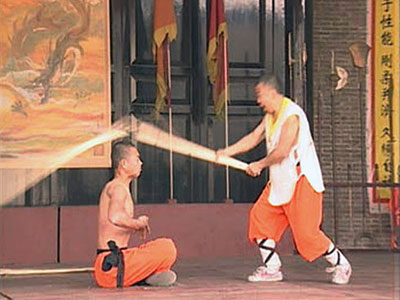
Taekwondo(Korea) vs Kung fu(Shaolin,China)
Without doubt, Buddhism has had a profound influence on kung-fu. Most styles, indeed most Asian martial arts, trace their lineage directly or indirectly to the Shaolin Temple. Further, Chinese folklore is filled with the heroic exploits of Shaolin monks such as T’an Tsung. But the association of a brutal fighting tradition with an altruistic religious order seems, at the very least, an improbable feat of history.
The very existence of a Shaolin warrior priest raises an obvious question: How could that happen?
According to the most popular account, unarmed combat was first brought into China in 520 AD by an Indian missionary named Bodhidharma (Ta Mo in Chinese), meaning “Way of Enlightenment.” At that time in history, the Northern Wei monarchy (386 – 534) was sympathetic to all sects of the Buddhist religion. In fact, a Chief of Monks was appointed to the Imperial Court to regulate all monastic activities in the kingdom. Bodhidharma apparently petitioned the Court for patronage, and was granted permission to found a monastery at the temple on the northern side of Shao-shih Mountain. This temple and monastery became the famous Shaolin Temple of Honan Province.
While at the temple, Bodhidharma supposedly taught that enlightenment (nirvana) could only be achieved by following the example of the historical Buddha at his moment of enlightenment, that is, through meditation. However, he soon realized that his disciples could not stay awake through the long hours of meditation that he demanded.
To remedy the problem, he instituted a regular exercise program. It consisted of the shin pa lo-han sho (Eighteen Movements of the Lo-Han Hands) exercise set as described in Bodhidharma’s I Chin Ching (Muscle Change Classic) and, most importantly, the study of Eighteen-Monk Boxing.
Bodhidharma was allegedly the third son of King Sugandha of Conjeeveram in Southern India, and thus a member of the warrior caste. As a boy, he would certainly have been required to study the unarmed fighting art called vajramushti yudda.Vajramushti yudda was undoubtedly influenced by pankration, the martial art of the invading army of Alexander the Great which occupied parts of India in the fourth century BC.
Owing largely to this legendary account of Bodhidharma, a few research historians have hypothesized a Greek origin for kung-fu. Certainly, during his 1970 trip to India to scout possible locations for the film Circle of Iron, Bruce Lee sought out an East Indian link between pankration and kung-fu only to be disappointed by India’s lack of a sophisticated martial art.
The entire Bodhidharma legend must be evaluated in the context of the times, especially in light of Bruce Lee’s chagrining discovery. The religion of the early Chinese took the form of ancestor worship. Ancestor worship so permeated the society that, in later years, social prestige and respectability were gleaned from being able to trace one’s family back to some mythical hero who performed superhuman deeds.
Eventually the custom arose of attributing a noble origin to all important cultural
phenomena. Even today, many Chinese will try to trace the origin of acupuncture,
or the yin and yang, back 5,000 years to some semi-legendary monarch.
It is no more surprising that Shaolin monks would attribute the origin of kung-fu to Bodhidharma – their equivalent of the first Pope – than it is that the ancient Greeks traced the origin of their boxing to Theseus. But the truth is, aside from the legend, absolutely no historical evidence supports this claim.
Although the legend probably does refer to some real Indian missionary, there is no record of a Bodhidharma in India itself, a fact which casts doubt on his noble birth. Obviously, all source material on the man’s life comes from Chinese writings, and the earliest Chinese reference to him does not appear until more than a century after his
death. The first link between him and the martial arts does not begin until several centuries after that date. Further, there is no trace of Bodhidharma’s book, the I Chin Ching before 1835. The book’s pedigree is likely a hoax, possibly intended to wrest credit from the Taoists for inventing the internal fighting systems (Tai Chi Chuan, Pa-Kua, Hsing-i).
Chinese boxing had already been refined to a most sophisticated art by the time of the Han monarchies (206 BC – 220 AD). The progressive Han emperors were the first to take an active interest in the development of the martial arts as we know them today. Military manuals and historical descriptions from the first century AD prove that, centuries before the time of Bodhidharma, external kung-fu systems were already far advanced beyond any fighting systems known to be indigenous to India in that era.
So while the beginning of kung-fu is a small mystery, the origin of the incongruous Shaolin boxing tradition remains a large mystery. Perhaps part of the answer lies buried in the Ch’an religion itself.
Complete Article Here
http://www.scifighting.com/2014/08/25/32447/importance-philosophical-fighting-art/
Source: Shaolin Monk vs Taekwondo Master (HQ) – YouTube
Related Posts
-
 MEET TANAKA: THE ARMORED WARRIOR OF HARDCORE
-
 Why You Ought To Know About Tibetan Martial Arts
-
 Taekwondo Legend Steven Lopez Continues To Shine, Wins Pan Ams Medal At 36.
-
 Luke’s an international Amazing Taekwondo Smash!
-
 Master The Skills of Effective Tactical Ninjutsu and Be Successful.
-
 Adriana Lima seriously boxing!
About The Author

Dojo
Taekwondo (English pronunciation /ˌtaɪˌkwɒnˈdoʊ/ or (thai-KWAN-doh): also transcribed as Taekwon-Do or Tae Kwon Do) is a Korean martial art with a heavy emphasis on kicks. Taekwondo was developed during the 1940s and 1950s by various Korean martial artists, as a blend of the indigenous Korean fighting styles of taekkyeon, gwonbeop, and subak, with influence from foreign martial arts, such as Karate and Chinese martial arts.
