7 Differences between American and Korean TKD
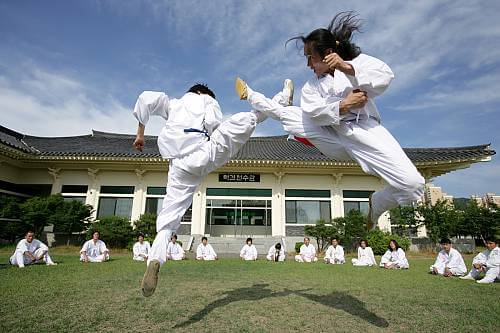
VIDEO: SEE THE AWESOMENESS THAT IS TAEKKYEON THE ANCIENT STYLE OF TKD IN ACTION! Watch video below..
Taekkyeon is a Korean martial arts focused on low kicks, leg sweeps, trips, pushes, etc. Taekkyeon is also characterized by rhythmic and almost dance-like movements.
The earliest existing written source mentioning Taekkyeon is the book Jaemulbo (also Manmulbo), written by Lee Sung-Ji during the reign of Jeongjo
Taekkyeon contains many kinds of techniques, including hand and leg techniques as well as joint locks, throws and head butts. The whole body is used in each movement. Taekkyeon teaches a great variety of kicks, especially low kicks, knees, jumps. The basic steps are geometric and at the core of all advanced movement. All movements are natural to the human body.
The movements of Taekkyon are fluid with the practitioners constantly moving. One of its most striking characteristics is the motion called gumsil or ogeum jil: It is a constant bending and stretching of one’s knees, giving the art a dance-like appearance. This motion is also used in the Korea mask dance talchum, so both arts look similar in a way. Taekkeyon does not make use of abrupt knee motions. The principles and methods used to extend the kick put more emphasis on grace and alignment for whole-body strength, as with the arm motions.
In competition, the players must use a foot work called pumbalkki (품밟기) which looks like a dance. The meaning of pumbalkki is “to step the pum”. Pum refers to the triangular look of the hanja 品, as pumbalkki has a triangular form as well. The hanja pum means “level” or “goods”, but it is used only because of its shape, not because of its meaning.
There are no set forms nor a fixed curriculum within the traditional system. Masters may create their own personalized system for teaching the basic techniques.
Related Posts
-
 Taekwondo Song | Baby Songs | Kids Learning Songs & Nursery Rhymes
-
 Who would of thought… Combining Snow Fruit and Water Karate is actually very deadly in King Legacy
-
 UFC 257 Recap: Dustin Poirier knocks out Conor McGregor | ESPN MMA
-
 Conor McGregor on UFC 246, Khabib, Mayweather | Extended Interview | Ariel Helwani’s MMA Show
-
 Lowkin’ Talkin’ MMA #32 – Khabib vs. McGregor | UFC 229 | KSW 45
-
 Why Do So Many MMA Fans Think Fights Are Fixed?
About The Author

Dojo
Taekwondo (English pronunciation /ˌtaɪˌkwɒnˈdoʊ/ or (thai-KWAN-doh): also transcribed as Taekwon-Do or Tae Kwon Do) is a Korean martial art with a heavy emphasis on kicks. Taekwondo was developed during the 1940s and 1950s by various Korean martial artists, as a blend of the indigenous Korean fighting styles of taekkyeon, gwonbeop, and subak, with influence from foreign martial arts, such as Karate and Chinese martial arts.
